
Beyond the Baseline: Strategic HVAC Selection for Midscale and Limited-Service Hotel Profitability
For midscale and limited service hotels, the choice of the Heating, Ventilation, and Air Conditioning (HVAC) system represents a significant portion of the total construction budget and dictates long-term operating costs. A strategic selection that balances upfront investment with energy efficiency, maintenance ease, and critical guest comfort standards is paramount to maximizing profitability. We analyze the three primary technologies used in this sector—PTAC, VTAC, and VRF—to guide developers toward the optimal system for their unique project profile.
2/11/20262 min read
Analyzing the Core Systems for Hotel Guestrooms
1. PTAC (Packaged Terminal Air Conditioner)
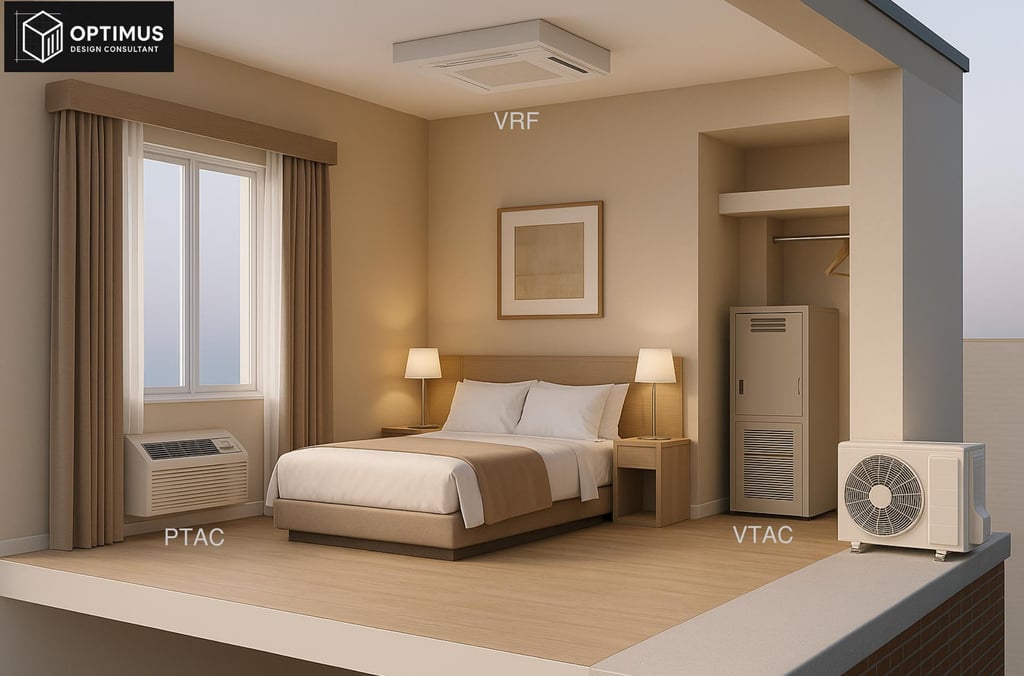
The Basics: A self-contained, through-the-wall unit providing localized heating and cooling for a single room. PTACs utilize a simple refrigeration cycle and often include electric resistance or heat pump options for heating.
Installation & Space: These units are typically mounted under a window on an exterior wall, requiring minimal interior infrastructure beyond the unit sleeve and electrical connection. They are favored for their simplicity and ease of installation and replacement.
Outside Air: Standard PTACs do not adequately condition fresh air. Code-required dehumidified outside air (DOAS) must generally be delivered to the guestroom via a separate, dedicated ductwork system.
2. VTAC (Vertical Terminal Air Conditioner)
The Basics: A vertical, compact, packaged system that operates similarly to a PTAC but is designed to be fully recessed. This allows the unit to condition one or more adjacent rooms.
Installation & Space: VTACs require a dedicated internal closet or corner enclosure, with air distributed through short duct runs. While requiring interior floor space (typically in the entry foyer or a closet), this design eliminates the visible wall unit, offering superior aesthetics.
Operation: Like PTACs, heating is typically achieved via heat pump or electric elements. Outside air often requires integration with a dedicated DOAS system.
3. VRF (Variable Refrigerant Flow)
The Basics: A highly efficient, centralized system. A single outdoor condensing unit connects to multiple individual Fan Coil Units (FCUs) in the guestrooms via refrigerant piping.
Installation & Space: The FCUs are often concealed above a ceiling or in a bulkhead, providing the best aesthetic integration. The outdoor unit can be placed on the roof or at grade.
Efficiency and Operation: VRF systems are renowned for their Variable Refrigerant Flow capabilities, allowing the system to modulate its capacity precisely to meet the instantaneous demand of each room. Advanced VRF systems with heat recovery can simultaneously cool one room while using the rejected heat to warm another room, dramatically boosting energy efficiency.
Outside Air: VRF FCUs are typically designed to integrate directly with a DOAS that provides ventilation air to the guestroom.
Key Factors in System Selection
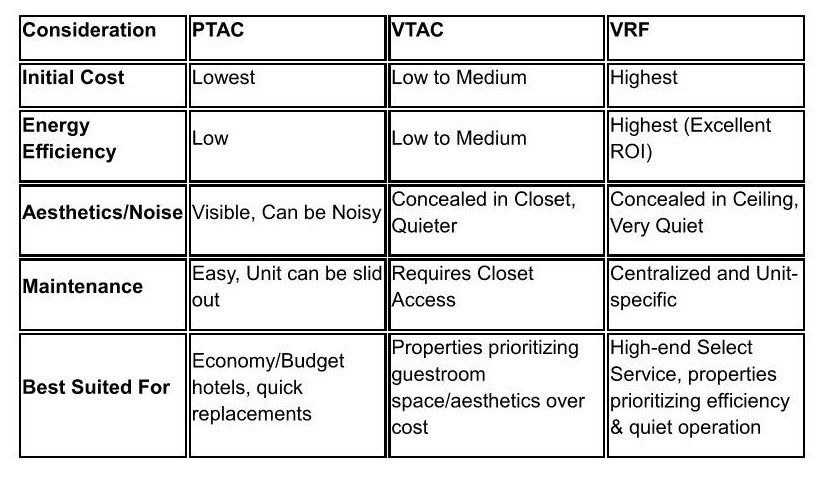
The selection process should move beyond initial cost to evaluate long-term maintenance, operational efficiency, and spatial requirements:
Consult Our Design Experts
Choosing the right system for a new development requires a comprehensive mechanical analysis tailored to the project’s specific climate zone, utility costs, and brand mandates. An optimized HVAC design ensures guest comfort, compliance, and controlled maintenance spending for the life of the property.
Don't rely on default or least expensive options.
We provide detailed MEP consulting services to determine the most beneficial and code-compliant HVAC solution for your hotel. Consult with our engineering team today to design a system that delivers maximum guest satisfaction and minimum operational expense.
Thank you,
Pratik
Founder, Optimus Design Consultant
High- quality BIM design and MEP coordination services tailord to your project needs.
ConTACT
GET IN TOUCH
© 2026 Optimus Design Consultant. All rights reserved.
Follow us on
services