
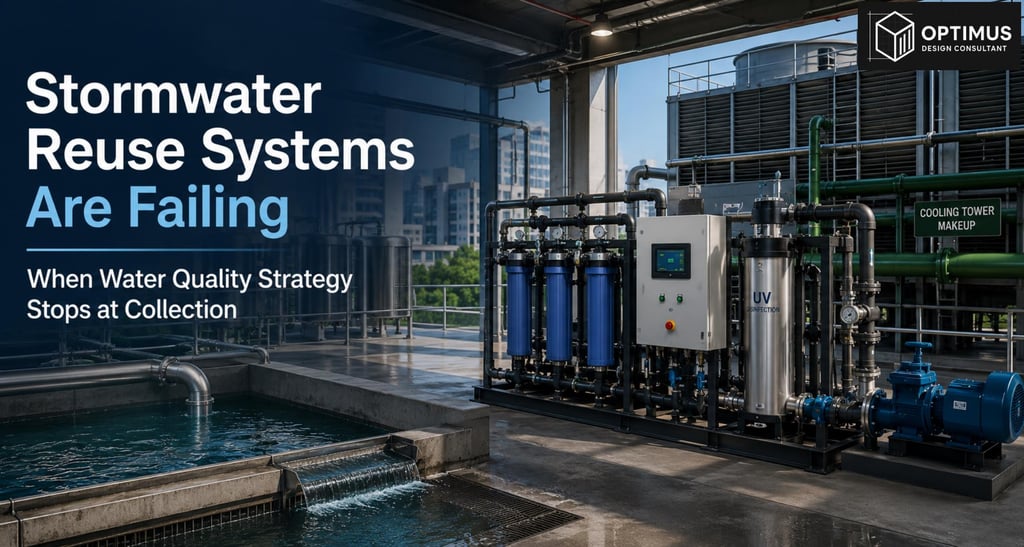
Stormwater Reuse Systems Are Failing When Water Quality Strategy Stops at Collection
Stormwater reuse systems are rapidly evolving from sustainability upgrades into mission-critical building infrastructure across hospitality, multifamily, healthcare, and mixed-use developments. As water costs rise and resiliency requirements increase, developers are integrating reuse systems to support cooling towers, irrigation, toilet flushing, and other domestic non-potable applications. But long-term performance depends on far more than stormwater collection alone. Without engineered treatment sequencing, disinfection control, and operational coordination, these systems can introduce hidden maintenance burdens, equipment failures, and water quality risks after occupancy.
5/20/20263 min read
Why are stormwater reuse systems creating operational problems even when cistern sizing, drainage collection, and storage infrastructure are properly installed?
Many systems perform well during initial startup but begin developing water quality instability, cooling tower fouling, and maintenance issues once buildings transition into full operation.
Review Your MEP Coordination Strategy
The Problem
Stormwater reuse systems are often designed around capture volume and sustainability metrics while underestimating long-term treatment requirements.
As systems begin operating, common issues emerge:
Sediment accumulation inside cisterns and filtration systems
Reduced UV disinfection effectiveness caused by elevated turbidity
Biofilm development within cooling tower systems
Odor formation during low-flow or stagnant conditions
Increased scaling and fouling across heat exchange equipment
Cross-connection risks between potable and non-potable systems
These problems frequently appear after occupancy, when maintenance teams inherit systems that were coordinated spatially—but not operationally.
Root Cause
Stormwater quality is highly variable and changes continuously based on:
Surface runoff contamination
Organic loading conditions
Seasonal rainfall intensity
Hydraulic residence time within storage tanks
Roof debris and suspended solids carryover
Without proper treatment sequencing, suspended solids increase turbidity and reduce UV transmittance, directly impacting UV disinfection performance.
This becomes especially critical in cooling tower applications, where untreated makeup water accelerates:
Biofilm formation
Fouling and scale accumulation
Reduced heat transfer efficiency
Increased chemical treatment demand
Long-term equipment degradation
In many projects, filtration and UV systems are selected using nominal flow assumptions without validating actual stormwater quality conditions during peak loading events.
The Coordination Gap
Most failures originate during design coordination—not installation.
Typical coordination deficiencies include:
UV systems selected without validating turbidity limitations
Undersized filtration equipment during high sediment loading conditions
No maintenance bypass strategy during filter replacement
Missing service clearance around treatment skids and UV chambers
Lack of controls coordination between cistern levels, filtration systems, and cooling tower makeup demand
Inadequate separation and labeling of potable and non-potable piping systems
BIM can coordinate pipe routing and equipment placement—but it cannot predict water chemistry behavior, sediment loading, or long-term maintenance constraints.
Code & Standard Alignment
Stormwater reuse systems intended for non-potable applications must comply with IPC requirements related to reclaimed water distribution, backflow prevention, cross-connection control, and piping identification.
UV systems should align with U.S. EPA Ultraviolet Disinfection Guidance Manual (UVDGM) recommendations and applicable ANSI/NSF standards where required by local AHJ approval pathways.
Where reuse water interfaces with cooling tower systems, ASHRAE 188 water management planning becomes increasingly important for controlling Legionella risk and maintaining long-term operational hygiene.
However, code compliance alone does not guarantee treatment reliability or operational performance under real project conditions.
Design-Stage Fix
High-performance stormwater reuse systems should include:
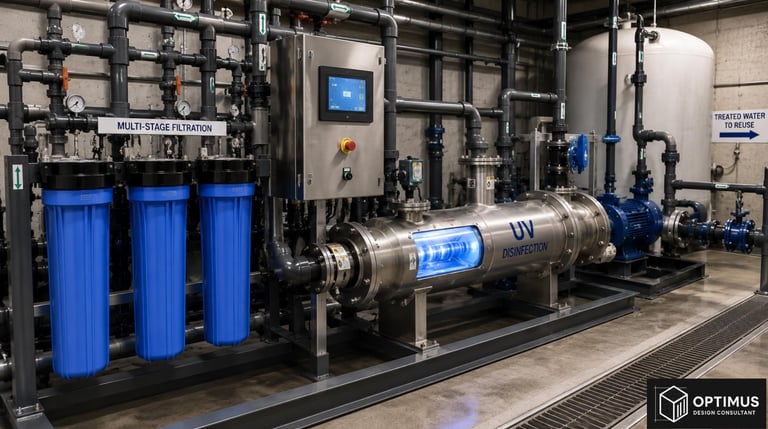
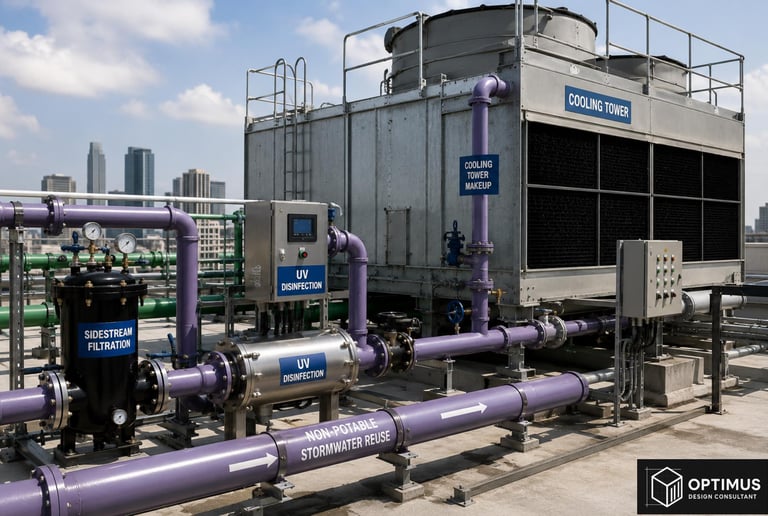
Multi-stage filtration upstream of UV systems to maintain low turbidity conditions
UV sizing based on actual operating flow rates and UV transmittance assumptions
Cooling tower sidestream filtration strategies to reduce suspended solids and biofilm growth
Isolation valves and bypass provisions for uninterrupted maintenance access
Online monitoring for UV intensity, pressure differential, flow conditions, and alarm status
Dedicated potable/non-potable piping separation coordinated during BIM development
Water quality assumptions documented during basis-of-design development rather than deferred until commissioning
Projects considering potable or domestic reuse applications may additionally require:
Reverse osmosis (RO) treatment
Advanced oxidation processes (AOP)
Mineral stabilization
Secondary disinfection systems
Additional recirculation and storage treatment strategies depending on local AHJ approval requirements
Field Insight
On fast-track developments, stormwater systems are frequently designed around cistern sizing and irrigation demand calculations alone.
Treatment performance, maintenance access, operational monitoring, and long-term water quality management are often addressed late in construction—or overlooked entirely.
The result is a system that achieves sustainability goals on paper while creating operational risk after turnover.
Capturing stormwater is easy—maintaining long-term water quality performance is the real engineering challenge.
Discuss Your Next Project
Consult with Our MEP Specialists
Stormwater reuse systems require more than storage tanks and drainage collection infrastructure. Long-term performance depends on how filtration, disinfection, controls, maintenance access, and operational sequencing are integrated during design.
Without coordinated water quality strategies, reuse systems can introduce hidden maintenance costs, cooling tower performance issues, equipment degradation, and public health risks despite meeting basic code requirements.
At Optimus Design Consultant, we integrate BIM-driven coordination with constructability-focused MEP engineering to support resilient, code-aligned water reuse infrastructure for modern building developments.
If your project includes stormwater recovery, cooling tower integration, or domestic non-potable reuse applications, early-stage engineering coordination will directly impact long-term operational reliability and building performance.
Thank you,
Pratik
Founder, Optimus Design Consultant
High- quality BIM design and MEP coordination services tailord to your project needs.
ConTACT
GET IN TOUCH
© 2026 Optimus Design Consultant. All rights reserved.
Follow us on
services